To prove a customer approved a quote, keep seven things: the exact document they saw, which option they chose, who approved it, when, how it reached them, the terms shown at that moment, and something showing none of it has changed since. A signature is only one of the seven. Most approval arguments are not about whether the customer said yes. They are about what they said yes to. This is general information for contractors, not legal advice; your attorney knows your state.
What counts as proof a customer approved a quote?
Proof of approval is a record that lets someone who was not there, such as a card issuer, an insurer or a judge, answer seven questions without taking your word for it. Each question has its own piece of evidence.
| # | What to keep | The question it answers |
|---|---|---|
| 1 | A frozen copy of the quote as the customer saw it | What exactly was approved: scope, lines, price? |
| 2 | The option chosen, and anything they declined | Which of the two or three options, and what was left off? |
| 3 | The name and email or phone number of the approver | Who said yes? |
| 4 | The date and time of approval | Was it before the work started? |
| 5 | Where the quote was sent and where the approval came from | Did it reach the right person? |
| 6 | The terms, warranty and any cancellation notice shown | What conditions did they agree to? |
| 7 | A copy both sides received, plus a way to show yours is unchanged | Is this the same document, or was it edited afterward? |
Number 7 is the one most shops miss. If the only copy lives in a system where the quote can still be edited, the other side can say the price or scope was changed after they agreed. Emailing the customer a PDF at the moment of approval fixes most of that, because now two copies exist and one is in their inbox.
A quote and an estimate are not the same promise. If you are unsure which one you are sending, read quote vs estimate first.
Is a verbal okay or a text reply enough?
A verbal okay or a one-word text can be a real agreement, but it leaves you with very little to show. The problem is evidence, not validity. Compare what each common way of approving leaves behind, measured against the seven items above.
| How the customer approved | What was approved (1, 2) | Who and when (3, 4) | Terms shown (6) | Unchanged copy (7) |
|---|---|---|---|---|
| Verbal okay on the driveway | No | Only your own note | No | No |
| Text reply such as "ok go ahead" | Only if the full quote is in the same thread | Phone number and timestamp | Rarely | Your phone's copy of the thread |
| Signed paper quote | Yes | Yes, if it is dated | Yes, if printed on it | Yes, if the customer kept a copy |
| Online approval of a quote link | Yes | Yes | Yes | Yes, if the system freezes the quote and emails a copy |
A verbal okay still has a place. For a small add-on found mid-job, stopping work to collect a signature costs more than the risk. Write a note on the job at that moment: who said yes, to what, at what price, and the time. For how to price those add-ons, see how to price change orders.
Is a typed name a legal signature?
Under federal law, a signature or contract cannot be denied legal effect only because it is electronic. That is the general rule of the E-SIGN Act, 15 U.S.C. 7001(a). The same section adds conditions that shape what a good approval record looks like:
- Nobody has to agree to do business electronically. Section 7001(b)(2) says the law does not require a person to use or accept electronic records or signatures. That is why a careful approval page asks the customer to agree to receive the quote electronically before showing it.
- Notices that a law says must be "in writing" need consent first. Under 7001(c)(1), an electronic record satisfies a consumer written-notice requirement only if the consumer affirmatively consented after being told, among other things, that they can have a paper copy and can withdraw consent.
- A recorded phone call is not a substitute. Under 7001(c)(6), an oral communication or a recording of one does not count as an electronic record for those consumer notices.
- The record has to last. Under 7001(d) and (e), an electronic record meets a retention requirement if it accurately reflects the contract, stays accessible to everyone entitled to it, and can be accurately reproduced later.
State law also applies, and some states set their own rules for home improvement contracts. Whether a typed name meets the rule for a particular sale in your state is a question for your attorney.
Do you have to give a three-day right to cancel?
Sometimes. The FTC's Cooling-Off Rule gives a buyer three business days to cancel certain sales made at their home. According to the FTC's consumer guidance, the rule does not cover a sale made because the customer asked you to come to their home to repair or maintain something, but items bought beyond that request are covered. Sales needed to meet an emergency and sales made entirely online, by mail or by phone are also listed as not covered.
| Cooling-Off Rule detail | Figure | Source |
|---|---|---|
| Smallest sale covered at the buyer's home | $25 | FTC consumer guidance |
| Smallest sale covered at a temporary location | $130 | FTC consumer guidance |
| Deadline to cancel | Midnight of the third business day after the sale | FTC consumer guidance |
| Days that count as business days | Monday to Saturday, except federal holidays | FTC consumer guidance |
| Cancellation forms the seller hands over | 2 copies | 16 CFR 429.1(b) |
| Seller's deadline to refund after a cancellation | 10 business days | 16 CFR 429.1(g) |
For an HVAC shop that means a requested repair call sits on one side of the line, and a replacement system sold at the kitchen table during that call may sit on the other. The regulation, 16 CFR 429.1, also requires telling the buyer about the right to cancel at the time of the sale. The FTC notes that some state laws give buyers more rights than the federal rule. If a cancellation notice applies to your sale, the copy the customer received, with its date, is part of your proof. Ask your attorney which of your sales need one.
What will a card company ask for if the customer disputes the charge?
A card dispute is where an approval record gets tested most often. For an in-person service, Stripe's dispute documentation names the date of service, documentation such as a signed contract, work order or other written agreement, the customer's signature, and your communication with the customer. Its evidence guidance adds the customer's name, email address and the IP address used for the purchase. Where a refund is the argument, it asks for your refund or cancellation policy as it was shown to the customer.
It also sets limits. Evidence must be PDF, JPEG or PNG, no more than 4.5 MB combined and fewer than 50 pages combined, with only the relevant excerpts. A short, dated record that shows the approved option, the name typed and the terms on the page fits that. A folder of screenshots from a tech's phone does not.
Take an example. A customer approves the Good option on a system replacement at $9,139 and pays a 10% deposit of $913.90 by card. Two weeks later the deposit is disputed as unrecognized. With the frozen quote, the name and email typed at approval, the timestamp, the IP address and the emailed PDF, the response is one short file. With a verbal okay, it is your word against theirs.
How much proof does each size of job need?
Match the effort to the money at risk. The limits below are an example for a small residential shop, not a rule. Set your own, write them down, and have every tech follow the same ones.
| Job size (example limits) | Approval to collect | Extra step |
|---|---|---|
| Under $500 | Verbal okay, noted on the job with name, price and time | None |
| $500 to $2,500 | Customer approves the written quote on a phone, with a typed name | Copy emailed to the customer |
| Over $2,500 | Same, sent to the customer's own email or phone | Email code check, and a deposit paid at approval |
A deposit is itself evidence. A payment made minutes after approving, from the customer's own card, is hard to square with "I never agreed to this." For when and how much to ask, see how to get paid faster.
How long should you keep approval records?
Keep an approval record at least as long as someone could still raise a claim about the job and as long as any warranty you gave on it. Both periods vary by state and by contract, so ask your attorney or insurer for the number that applies to you. In practice storage is cheap and a missing record is not, so keep them for years, in a place where they cannot be edited, and where they survive a tech leaving or a phone being replaced.
How to keep the record in Pricebookr
Pricebookr's online quote approval and deposits collects the seven items as part of sending a quote. It is included on Starter at $49 a month.
- Under CRM, CRM Admin, Quotes, Quote approval, an admin adds the shop's terms and conditions and, if it applies, turns on the three-day right-to-cancel notice. An email code can be required on every quote or only at or above an amount you choose.
- Build the quote with one to three options, set a deposit as a percentage or a fixed amount, and send it by text or email. How to build a good-better-best HVAC quote covers the options.
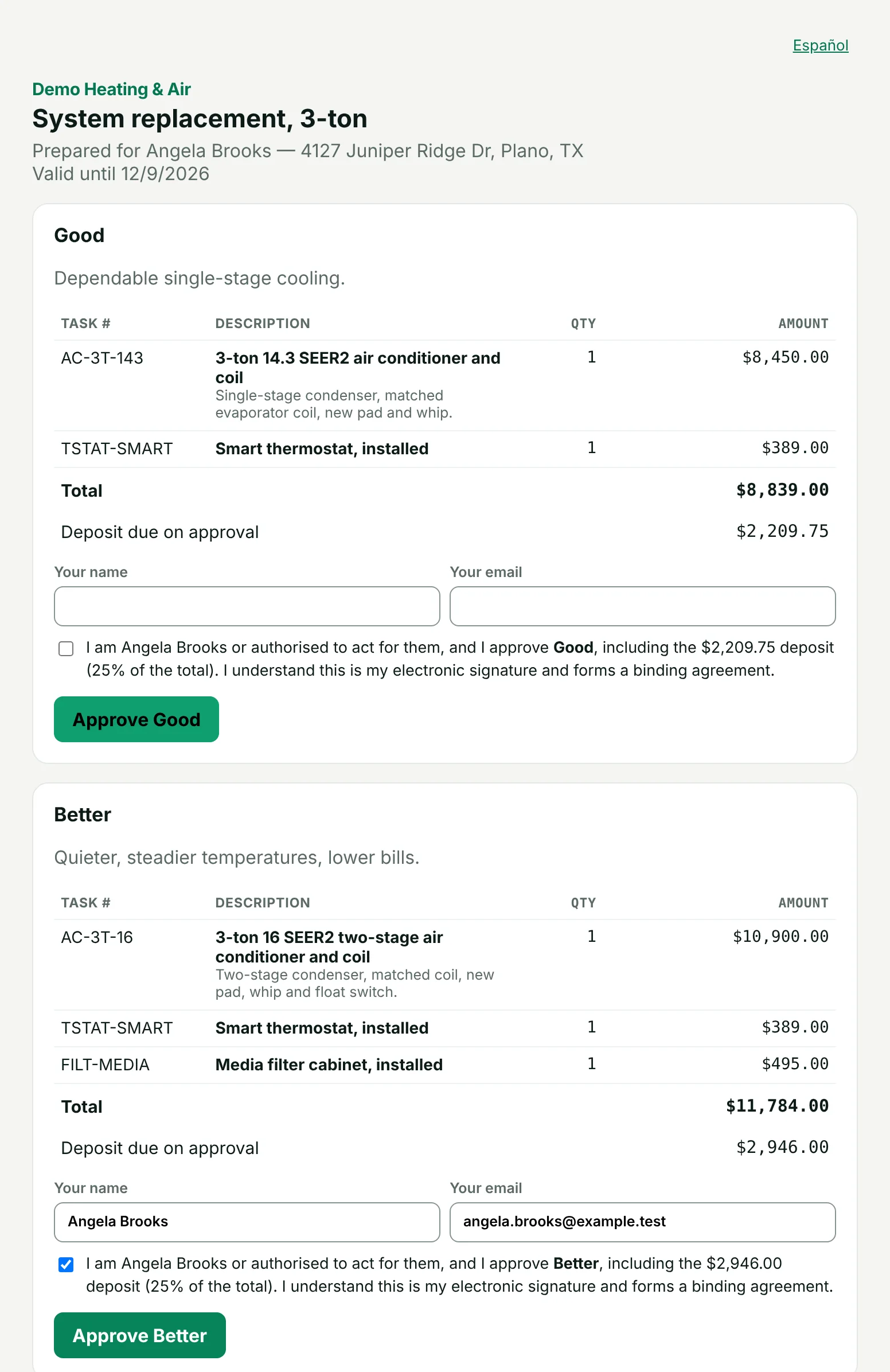
- The customer first agrees to receive the quote electronically. Then they pick one option, type their name and email, tick the box confirming it is their electronic signature, and approve.
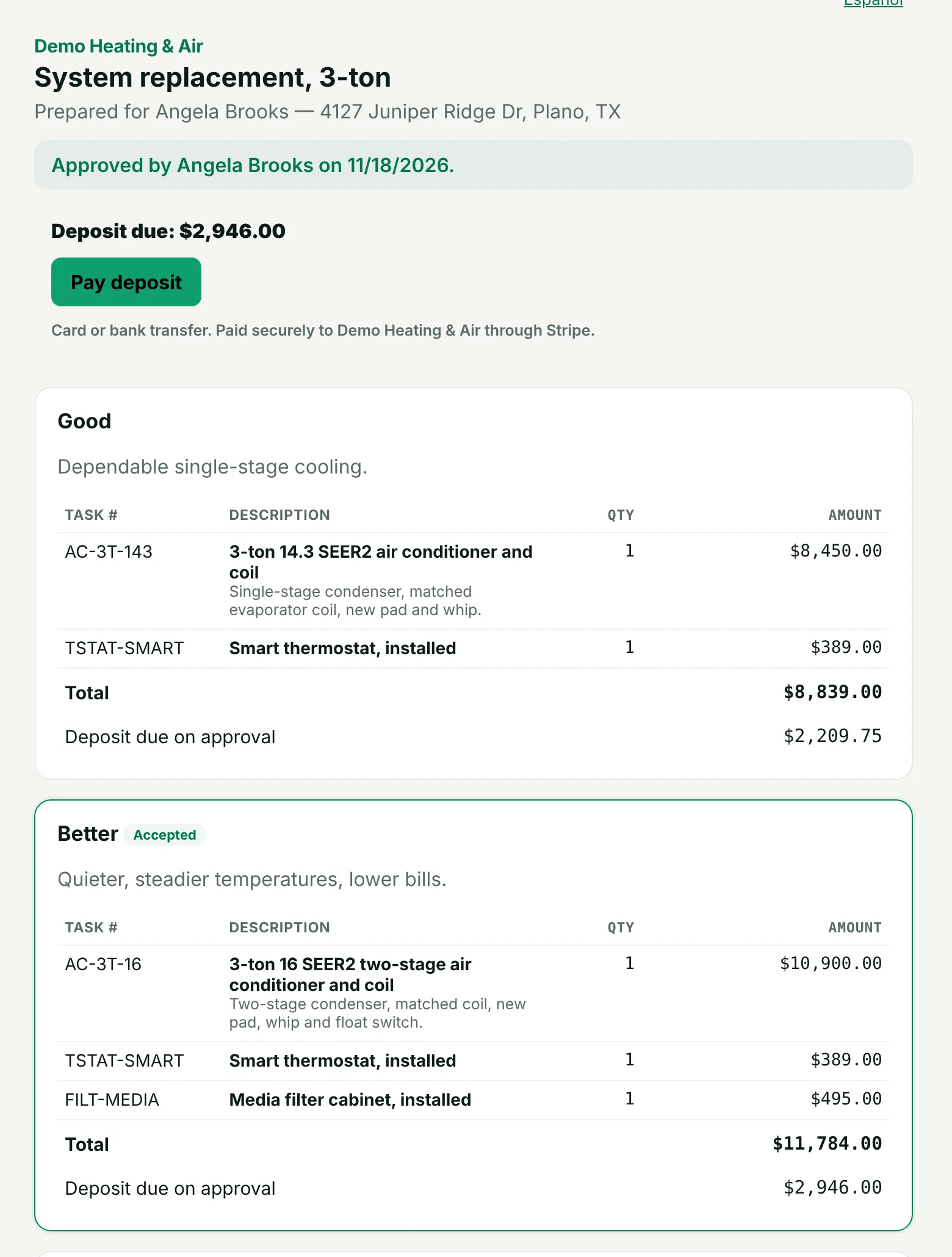
- If a deposit is set and the shop takes card and bank payments, the page shows the deposit due and a Pay deposit button straight after approval. The deposit comes off the final invoice.
- Both sides are emailed a PDF copy. Pricebookr freezes a copy of the quote as the customer saw it, stores its SHA-256 fingerprint, and keeps the approved document for seven years in storage that cannot be edited or deleted.
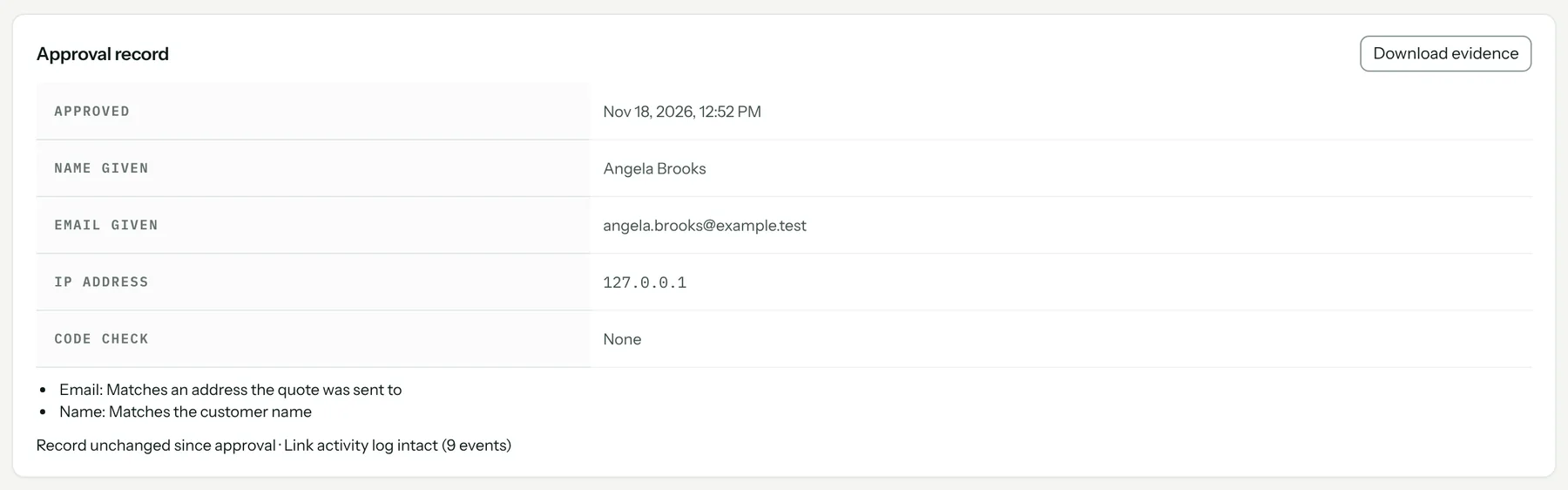
- Open the approved quote to see the Approval record: date and time, the name and email given and whether they match what you had, the IP address, and whether a code was checked. Download evidence gives a .zip with the certificate, the customer's PDF, the frozen quote, the link's activity log and instructions for checking the fingerprint without Pricebookr.
The email code proves the customer could read mail at that address, not who they are. Anything the customer unticks is kept as declined and signed by them. If the office takes an approval by phone and marks the quote accepted, the record says it was entered by staff. In the phone app, jobs under the shop's own limit go ahead on a recorded verbal okay; at or over it, the tech hands the customer the phone to approve and sign. Full steps are in the help doc, How customers approve quotes and pay deposits. If a quote is out and not yet approved, see how to follow up on an HVAC quote.
FAQ
What is the best proof that a customer approved a quote?
The best proof is a frozen copy of the exact quote the customer saw, with the option they chose, their name, the date and time, where it was sent, and the terms shown. A copy emailed to the customer at that moment matters as much as the signature, because it shows the document was not changed afterward.
Is a text message saying "go ahead" a valid approval?
It can be an agreement, but it is weak evidence unless the full quote, price and scope are in the same thread. A text shows a phone number and a time. It does not show which version of the quote the customer meant or what terms they saw. For anything beyond a small add-on, send a written quote to approve.
Is a typed name a legal signature on a quote?
Federal law says a signature cannot be denied legal effect only because it is electronic (15 U.S.C. 7001). The customer should first agree to do business electronically, and the record must be kept in a form that can be accurately reproduced. Whether a typed name satisfies a specific state rule for your sale is a question for your attorney.
Does the three-day right to cancel apply to HVAC repairs?
The FTC's Cooling-Off Rule does not cover a sale made because the customer asked you to visit their home to repair or maintain something, or a sale needed to meet an emergency. The FTC says items bought beyond that request are covered. State laws can give more rights, so ask your attorney which of your sales need a cancellation notice.
Should a tech get approval before starting extra work found on the job?
Yes, every time, before the work starts. For a small add-on, a verbal okay noted on the job with the customer's name, the price and the time is usually enough. Above a dollar limit your shop sets, have the customer approve a written quote on a phone so the scope and price are on record.