To build a good-better-best HVAC quote, write three complete scopes for the same job, build each one from the same flat-rate tasks, and check the margin on every option before the customer sees any of them. The options should differ in equipment and in what is included, not in how carefully they were priced. The worked example below is a 3-ton air conditioner replacement quoted three ways, with cost, price, margin and deposit for each option.
What is a good-better-best HVAC quote?
A good-better-best quote is one document that offers the customer three ways to solve the same problem, each with its own scope and total. The customer picks one. Good is the honest minimum, Better is what you would put in your own house, and Best is the premium system with everything that protects it.
Why three options sell better than one is covered in good-better-best pricing for contractors. This post is the build: what goes on each option and how the numbers come out.
What goes in each option on a replacement quote?
Start with what is the same on all three, then decide what changes. On a replacement, the removal, the pad and electrical, and the permit are the same job whichever unit goes in. The equipment and the add-ons are what change.
| Option | Equipment (3-ton split AC and coil) | Added to the scope | Who usually picks it |
|---|---|---|---|
| Good | Single-stage, at the minimum efficiency allowed in your region | Nothing beyond a complete, code-compliant install | Rentals, tight budgets, owners who plan to sell |
| Better | Two-stage, around 16 SEER2 | Smart thermostat, media filter cabinet | Most owner-occupied homes |
| Best | Variable-speed, around 18 SEER2 | Smart thermostat, media filter cabinet, new line set, surge protector | Owners staying 10 years or more, comfort complaints |
Good still has to be legal. Since January 1, 2023 the federal minimum for a split-system air conditioner under 45,000 Btu/h is 13.4 SEER2 in the North and 14.3 SEER2 in the Southeast and Southwest, according to the Department of Energy's FAQ on the 2023 standards. A 3-ton unit is 36,000 Btu/h, so those are the floors for this example.
How do you price each option?
Price every option from flat-rate tasks. A flat-rate task is one priced line for a complete piece of work, with its material cost and book hours behind it. Book hours are the hours you sell for the task, whether the job runs fast or slow. If the same task appears on all three options, it carries the same price on all three.
The numbers below are an example, not a market price. They assume a burdened labor cost of $45 an hour, which is wages plus payroll taxes, insurance and benefits. Work out your own with the labor burden rate method, and replace the equipment costs with your distributor's.
| Flat-rate task | Your cost | Price | Good | Better | Best |
|---|---|---|---|---|---|
| Install single-stage AC and coil (10 book hours) | $3,350 | $6,450 | Yes | No | No |
| Install two-stage AC and coil (11 book hours) | $4,395 | $8,300 | No | Yes | No |
| Install variable-speed AC and coil (12 book hours) | $6,140 | $11,300 | No | No | Yes |
| Remove old equipment and recover refrigerant | $150 | $450 | Yes | Yes | Yes |
| New pad, disconnect and whip | $185 | $420 | Yes | Yes | Yes |
| Permit and inspection | $150 | $180 | Yes | Yes | Yes |
| Smart thermostat, installed | $175 | $390 | No | Yes | Yes |
| Media filter cabinet, installed | $205 | $460 | No | Yes | Yes |
| Replace line set | $355 | $780 | No | No | Yes |
| Surge protector at the condenser | $105 | $240 | No | No | Yes |
Good and Better reuse the existing line set, which is only acceptable when it is the right size for the new unit and holds a pressure test. If it is not, replacing it belongs on every option, not just Best.
What do the three totals and margins look like?
Add up each option and check gross margin, which is price minus direct cost, divided by price. If margin and markup are easy to mix up, markup vs margin for contractors sorts them out, and the margin and markup calculator does the arithmetic.
| Option | Direct cost | Price | Gross profit | Gross margin | 25% deposit |
|---|---|---|---|---|---|
| Good | $3,835 | $7,500 | $3,665 | 48.9% | $1,875 |
| Better | $5,260 | $10,200 | $4,940 | 48.4% | $2,550 |
| Best | $7,465 | $14,220 | $6,755 | 47.5% | $3,555 |
Three things to read from that table:
- The margin is nearly flat, and the dollars are not. All three options sit between 47% and 49%, but Best brings in $3,090 more gross profit than Good for two extra book hours on the install and a few short add-on tasks. Gross profit pays the overhead, so look at dollars as well as percent.
- The steps are even. Better is 36% above Good and Best is 39% above Better. Replacement quotes have smaller steps than repair quotes because the install labor is in all three.
- No option is a loss leader. If Good only works at a 30% margin, it is not a real option. Reprice it or take something out of the scope.
How much deposit should each option carry?
Set the deposit as a percentage so it scales with the option the customer picks. At 25%, this quote asks for $1,875 on Good and $3,555 on Best, which roughly covers the equipment order in each case. A fixed deposit would be too much on Good or too little on Best. Deposit size and timing are covered in how to get paid faster as an HVAC contractor.
What mistakes break a three-option quote?
- Three units, one scope. If the only difference is the model number, the customer compares price per SEER2 point and picks Good. Change what is included.
- Retyped prices. A thermostat that is $390 on Better and $350 on Best tells the customer the numbers are made up.
- Scope hidden in a total. Each option should list what is done, in the customer's words, so nobody argues later about whether the line set was included.
- No expiry date. Equipment costs move. Put a valid-until date on the quote and hold to it.
A quote is a fixed offer, not a guess. If you are not ready to hold the price, see quote vs estimate for contractors.
How do you build this quote in Pricebookr?
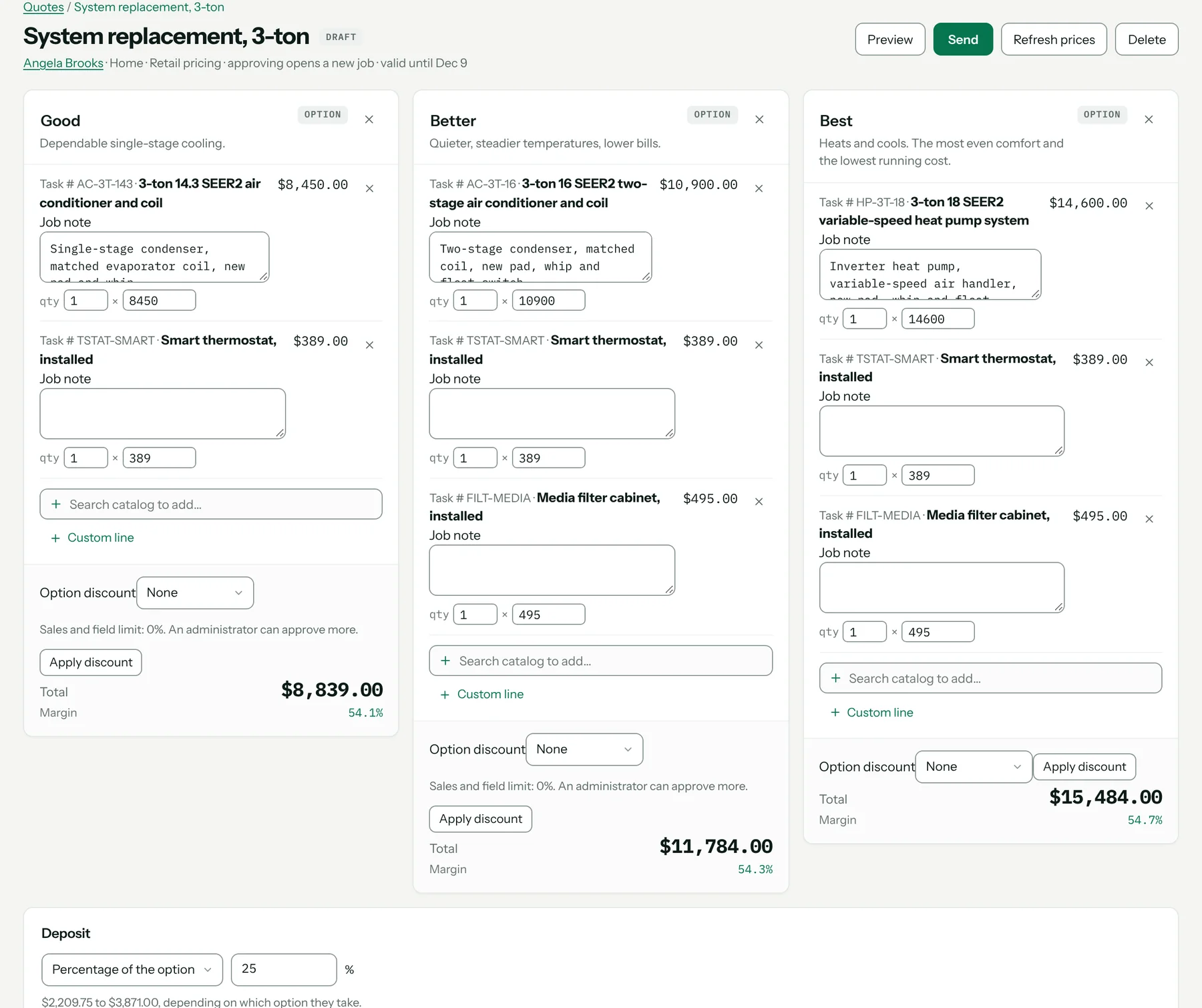
In Pricebookr the options are built from the tasks in your own price book, so the number on the quote is the number in the book. The steps, from the help article Build and send quotes:
- Go to CRM → Quotes, click + New quote, and pick the customer, a title, the price book and a valid-until date.
- Add lines to the first option by searching the catalog. Click Add option (Better) and Add option (Best) for the other two. A quote holds one to three options.
- Read the Total and Margin under each option. Margin is shown to staff who are allowed to see cost and never to the customer.
- In the Deposit panel choose a percentage. The panel shows the dollar range across the options.
- Click Preview to see the customer's page, then Send by email or text. In the field app, a tech can present the quote on the phone instead.
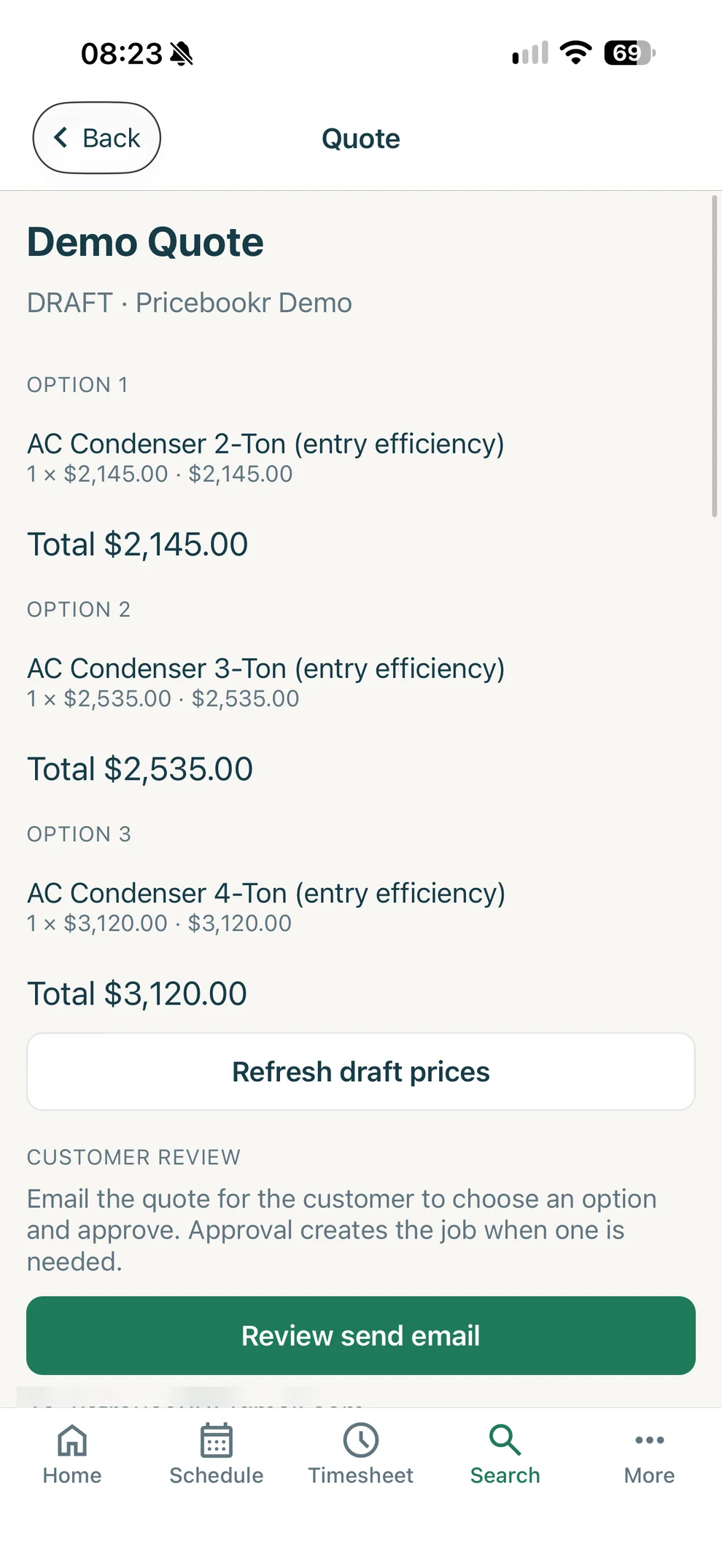
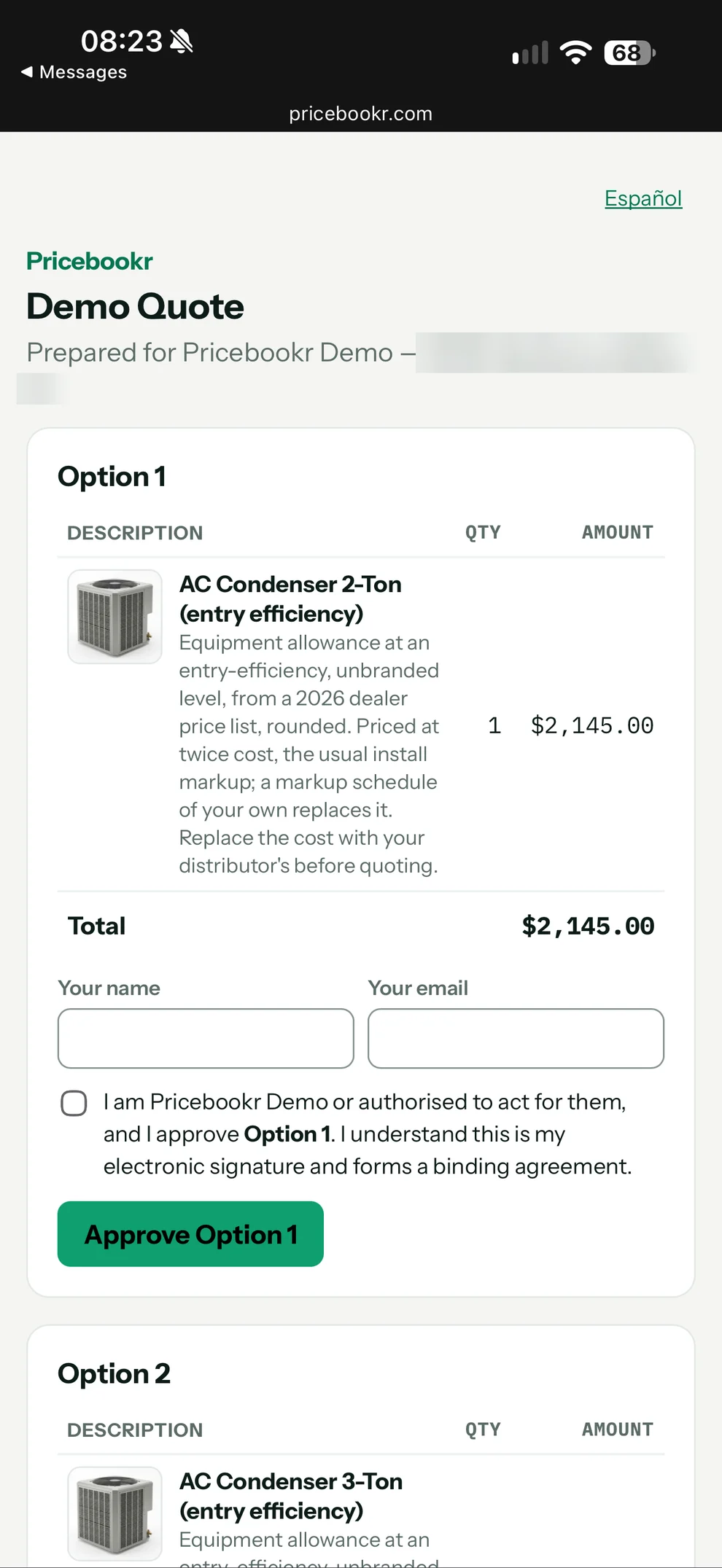
The customer opens the link, picks one option and approves it, and the deposit is paid on the same page. See good / better / best quotes, flat-rate tasks and quote approval and deposits.
Key takeaway: build all three options from the same flat-rate tasks, change the equipment and the scope between them, check that each one holds your margin, and set the deposit as a percentage so it follows the option the customer picks.
FAQ
What should the Good option include on an HVAC replacement quote?
The Good option should be a complete, code-compliant installation with equipment at the minimum efficiency allowed in your region: removal of the old unit, refrigerant recovery, pad and electrical, permit and startup. It leaves out upgrades such as a better thermostat or filtration. It must still be a job you would warranty and still hold your margin.
How far apart should good, better and best prices be on a system replacement?
Expect smaller steps on a system replacement than on a repair, because the install labor, removal and permit are in all three options and only the equipment and add-ons change. In the worked example, Better is 36% above Good and Best is 39% above Better. Make each step buy something the customer can name.
Should every option have the same profit margin?
Every option should meet your minimum gross margin, but they do not need to match exactly. In the example the three options run from 47.5% to 48.9%. What matters more is gross profit in dollars: the Best option earns $3,090 more than Good for only a few more hours of work.
Should the deposit be the same on all three options?
No. Set the deposit as a percentage of the option so it scales with what the customer chooses. At 25%, a $7,500 option needs $1,875 and a $14,220 option needs $3,555. A fixed amount ends up too high on the smallest option or too low to cover the equipment order on the largest.
Do I need three options on every quote?
No. Offer three when there are three real ways to solve the problem, which is almost always true on a replacement. A simple repair with one correct fix can go out as a single option. Padding a quote with options you would not recommend makes all of them look less trustworthy.