On every AC service call, record the air temperatures, refrigerant pressures, superheat, subcooling, total external static pressure, motor amps, line voltage and capacitor microfarads, each against the unit it was taken on, once before the work and once after. A reading only has value if someone can compare it later, so write down the conditions with it: outdoor temperature, operating mode and stage. The table below is the full set, what each reading is compared against, and a rule of thumb for each.
What readings should you record on every AC service call?
Record the readings that describe the three things an air conditioner does: move air, move refrigerant and draw power. The rules of thumb in this table are from Bryan Orr's five pillars of residential AC refrigerant circuit diagnosis (ACHR News, February 2020). He calls them rules of thumb and says to use the manufacturer's recommendations when setting a charge. Treat them the same way: the unit's literature and nameplate are the target, and these numbers are what tells you to look closer.
| Lectura | Compare it against | Rule of thumb |
|---|---|---|
| Return and supply air temperature (delta T) | Last visit, same conditions | 16–22°F split at 400 CFM per ton; higher at lower airflow |
| Outdoor air temperature | Nothing; it is the condition every other reading depends on | Record it every time |
| Suction pressure and saturation temperature | Return air temperature | Saturation about 35°F below return air, plus or minus 5°F, at 400 CFM per ton |
| Liquid (head) pressure and saturation temperature | Outdoor air temperature | Saturation 15–20°F above outdoor air on most modern systems |
| Superheat | Manufacturer's target or charging chart | About 10°F, plus or minus 5°F, with a TXV; use the chart on a fixed orifice |
| Subcooling | Manufacturer's target on the unit | Typically 8–14°F with a TXV |
| Total external static pressure | Maximum rated static on the air handler or furnace nameplate | 0.3–0.7 in. w.c. on most systems |
| Compressor, condenser fan and blower amps | RLA or FLA on the nameplate, and the last comparable reading | At or under the nameplate rating |
| Line and control voltage | Nameplate voltage | Record it with the amps; amps mean little without it |
| Capacitor microfarads | The rating and tolerance printed on the capacitor | Inside the printed tolerance |
The ratings you compare against come off the nameplate. If the model, serial, RLA and FLA are not on file yet, start with how to read an HVAC data plate.
Why take readings before and after the work?
Take one set of readings before you touch anything and one after the repair, because the pair is the only proof the visit changed something. The before set is the diagnosis. The after set shows the system left running inside its targets, and it is the baseline the next tech compares against.
David Richardson of National Comfort Institute made the same case for tune-ups in ACHR News: a checklist of yes boxes shows no improvement, and a static pressure test with supply and return temperatures, taken before and after, does. He puts the static pressure test at under five minutes and the added measurements at 15 minutes or less.
The after set also protects you. When a customer calls back in August saying it never cooled right, a 19°F split and 10°F of subcooling recorded on the day you left is a better answer than a tech's memory. What an undocumented return trip costs is in cómo cobrar las visitas de retorno.
What conditions make two AC readings comparable?
Two readings are comparable when they were taken in the same operating mode, at the same stage and at a similar voltage and outdoor temperature. Superheat at 75°F outdoors and superheat at 98°F outdoors are different measurements, and compressor amps on low stage say nothing about amps on high stage. Record these with every set.
| Condition | What to write down | Why it matters |
|---|---|---|
| Cuándo | Before work, after work, or recheck | Separates the diagnosis from the result |
| Operating mode | Cooling or heating | Targets differ by mode |
| Stage | Low, high, or the percentage on variable-speed equipment | Pressures and amps change with capacity |
| Outdoor air temperature | Dry bulb at the condenser | Head pressure and charging targets depend on it |
| Supply voltage | Volts at the contactor while running | Motor current moves with voltage |
| Target source | The chart or page the target came from | Lets the next tech check the target, not just the reading |
Give the system time to settle before you write anything down. A reading taken two minutes after startup describes the startup.
How do you record a capacitor reading so it means something?
Record the measured microfarads next to the rated microfarads and the tolerance printed on the capacitor, and work out the percentage of rating. "Cap weak" in the notes tells the next tech nothing. "41.2 µF on a 45 µF, plus or minus 6%" tells them exactly how far out it was. The numbers below are an invented example for a 45/5 µF dual run capacitor marked plus or minus 6%.
| Sección | Rated | Allowed at ±6% | Measured | % of rating | Resultado |
|---|---|---|---|---|---|
| HERM (compressor) | 45 µF | 42.3–47.7 µF | 41.2 µF | 91.6% | Outside tolerance |
| FAN | 5 µF | 4.7–5.3 µF | 4.9 µF | 98.0% | Inside tolerance |
Recorded this way, the reading also supports the repair on the invoice. The customer sees a rated number and a measured number, not an opinion.
What does a trend show that one reading can't?
A trend shows a part on its way out while every single reading still looks acceptable. Motor current is the clearest case. In this invented example, a condenser fan motor with a 2.4 A nameplate FLA is under its rating on all three visits, but its current has risen 10.5% in two years at the same voltage and mode.
| Visita | Condenser fan amps | Nameplate FLA | Change from first visit |
|---|---|---|---|
| Spring 2024 tune-up | 1.9 A | 2.4 A | Baseline |
| Spring 2025 tune-up | 2.0 A | 2.4 A | +5.3% |
| Spring 2026 tune-up | 2.1 A | 2.4 A | +10.5% |
None of those visits fails a pass-or-fail check. Together they are a reason to check the bearings, the blade and the capacitor before the motor quits in July. You only get the trend if the readings are stored against the unit, not on a paper invoice in a filing cabinet. This is also what makes a maintenance visit worth paying for; see how to track HVAC maintenance agreements.
Who should look at the readings afterward?
The owner or service manager should read a sample of recorded readings every week. In ACHR News (May 2019), contractor Allen Reed described doing exactly that and finding a call where the tech replaced a bad capacitor and left, while the recorded superheat was 26°F on a TXV rated for 7–9°F. The problem was in the numbers the tech had written down. Nobody had read them.
Two habits make the review possible. First, set one short routine per equipment type so every tune-up collects the same readings; five readings taken every time beat fifteen taken sometimes. Second, hold the routine to a published floor. ANSI/ACCA 4 QM – 2019 (R2024), reaffirmed in August 2024, is the standard ACCA describes as a nationally recognized set of minimum tasks for residential HVAC maintenance inspections, and it is free to download from ACCA.
How do you record readings in Pricebookr?
En Pricebookr, readings are saved against the unit, so the history is there on the next visit. The readings and diagnostics page covers what is included; the steps are:
- Once, in the office: under CRM Admin, Jobs & field, Routine measurements, pick an equipment type and tick the few readings techs should see for it.
- On the phone, open the job, then Equipment & readings, then Record measurements, and pick the unit.
- Set When to Before work, After work or Recheck, and set the operating mode. Stage and supply voltage are optional and make later comparisons fair.
- Fill in the routine fields, or tap Read meter photo and photograph the gauges or clamp meter. Each value read from a photo is shown beside a crop of the display for the tech to check before it is saved. Photo reads use Prycey credits.
- Tap Save readings. With no signal, the readings are queued on the phone and sent when it reconnects.
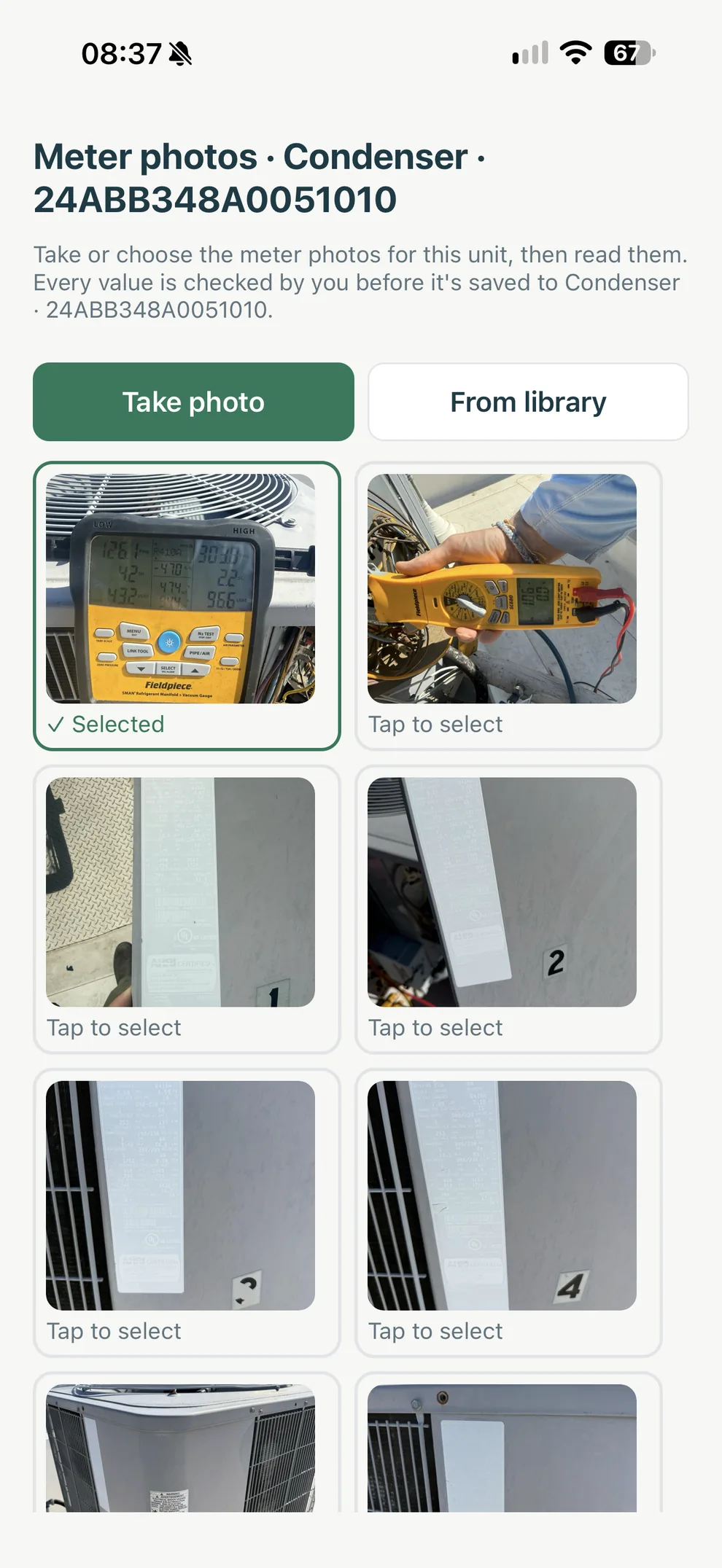
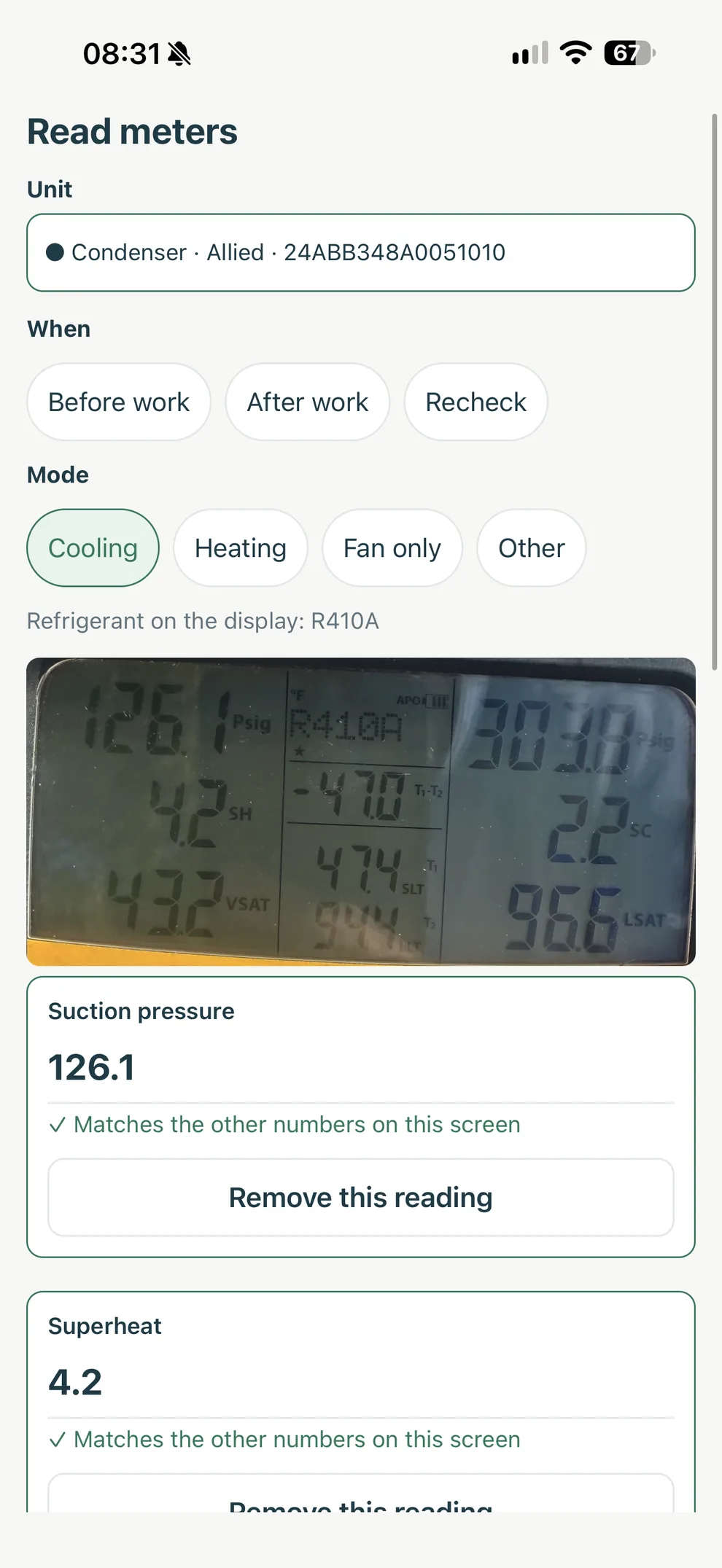
Under Measurement checks, Pricebookr lists what the readings show: microfarads against the rating, amps against the nameplate and the prior comparable reading, and superheat or subcooling against the range you recorded. On the Pro plan it adds suggestions of what to inspect. A check is never a pass-or-fail verdict.
What it does not do: it does not connect to Bluetooth probes or gauges, it does not look up OEM targets (you enter the range from the model's literature), and capacitor setup and capacitor readings are on the web only. Recording readings is on both plans, Starter at $49 a month and Pro at $89 a month. The full steps are in the help doc, Registra lecturas y pruebas de diagnóstico.
Preguntas frecuentes
What readings should an HVAC tech take on an AC service call?
Take return and supply air temperature, outdoor air temperature, suction and liquid pressure, superheat, subcooling, total external static pressure, compressor and fan motor amps, line voltage, and capacitor microfarads. Record each against the unit, with the operating mode and stage, once before the work and once after, so the next visit has a baseline to compare against.
What is a normal delta T for an air conditioner?
A common rule of thumb is a 16–22°F difference between return and supply air at about 400 CFM per ton, and higher at lower airflow. It is a rule of thumb, not a specification: humidity and airflow move it, so record indoor conditions with it and compare it with the same system's earlier readings rather than judging one number alone.
What should superheat and subcooling be on a residential AC?
The target is whatever the manufacturer specifies for that unit, usually printed on the unit or in its charging chart. As rules of thumb, a TXV system often runs about 10°F of superheat, plus or minus 5°F, and 8–14°F of subcooling. Fixed-orifice systems are charged by superheat from the manufacturer's chart, which changes with indoor and outdoor conditions.
How long does it take to record readings on a service call?
Less than most shops assume. David Richardson of National Comfort Institute puts a total external static pressure test at under five minutes and the measurements he adds to a tune-up at 15 minutes or less. A short fixed routine per equipment type keeps the time predictable and the readings comparable from visit to visit.
Should the customer see the readings?
Yes, as recorded and without a pass-or-fail label. A before-and-after table on the service report shows the customer what the visit changed and gives them something to keep. Leave the interpretation to the technician's recommendations: a number outside a rule of thumb is a reason to inspect, not proof that a part has failed.