To build a flat-rate task, write down five things for one complete repair: the book hours, the parts it uses, the scope the customer reads, one price, and a task number. The price comes out of the first two. The scope is what stops the price from being argued on the driveway. This guide builds one task from start to finish, a condenser fan motor replacement, with every number shown.
What goes into a flat-rate task?
A flat-rate task is one repair or install sold as a single line at a single price, whatever the clock says on the day. Behind that one line sit five parts, and each does a different job.
| Part of the task | Lo que es | What it protects |
|---|---|---|
| Horas previstas | The time the task is sold for | Your labor cost and your schedule |
| Included parts | Every part the job uses, with a quantity | Your material cost when supplier prices move |
| Alcance | What is included, what is not, and the warranty | The price, when the job turns out bigger than expected |
| Precio | One number the customer approves before work starts | Margen de Your |
| Task number | A short code that never changes | Your records: quotes, invoices and reports all point at the same task |
If you are still deciding whether flat rate suits your shop, read precio fijo vs tiempo y materiales first. This post assumes you have decided and are building the book.
How do you set book hours for a flat-rate task?
Set book hours by listing the steps of the job on site and timing each one for an average tech on an average day. Do not use your fastest tech's best time, and do not use a guess. Book hours cover the work from the moment the tech starts the repair to the moment the customer has been walked through it.
Here is the breakdown for replacing a condenser fan motor on a residential split system. The hours are an illustration; time your own crew before you use them.
| Paso | Horas |
|---|---|
| Kill and verify power, pull the top, remove the old motor and blade | 0.4 |
| Fit the new motor, set blade height, wire it, replace the run capacitor | 0.6 |
| Run test: check rotation and amp draw against the nameplate | 0.2 |
| Clean up, take photos, walk the customer through the repair | 0.3 |
| Horas previstas | 1.5 |
Three things are left out on purpose. Drive time, diagnosis and a run to the supply house are not part of this task. They are real costs, and they are recovered somewhere else: in a trip charge, a diagnostic fee or your hourly rate. Put them in the task and the same job costs a different amount depending on how far away the customer lives. See how to charge for travel time y should you charge a diagnostic fee.
What does a wrong book-hours number cost?
A task that runs over its book hours costs you the billable time you could have sold on another call. The loss is small per job and large per year, because a common repair is done dozens of times. This table assumes a task done 60 times a year and a billing rate of $165 an hour, both illustrations.
| Average overrun per job | Hours lost over 60 jobs | Billable time lost at $165 an hour |
|---|---|---|
| 0.25 hours (15 minutes) | 15 | $2,475 |
| 0.5 hours (30 minutes) | 30 | $4,950 |
| 0.75 hours (45 minutes) | 45 | $7,425 |
The fix is to compare book hours with clocked hours a few times a year and correct the tasks that run over job after job. One bad day is not a reason to reprice. Costeo de trabajos para contratistas covers how to run that comparison.
Which parts belong in a flat-rate task?
List every part the job uses every time, with its quantity and your current cost, including the small ones. A task that lists only the motor is short by the capacitor and the connectors on every single job. For the fan motor task:
- Condenser fan motor, matched to the old motor's horsepower, RPM and voltage: $95.00
- Run capacitor: $12.00
- Connectors, wire ties and a rain shield: $5.00
That is $112.00 of material at example costs. Parts that are needed only some of the time, such as a fan blade that turns out to be cracked, do not belong in the task. They go in the exclusions and are quoted as their own line when they come up.
The parts list is also what tells you when to reprice. When your supplier raises the motor from $95 to $110, the task's cost has moved $15 and its price should be checked. How to adjust pricing when material costs rise covers that routine.
How do you get from hours and parts to one price?
Work out the task's cost first, then its price, and keep the two apart. Cost is what the job takes out of your pocket. Price is what you charge, and it has to cover overhead and profit as well.
For labor cost, start from the wage and add burden. The U.S. Bureau of Labor Statistics reports a median wage of $29.33 an hour for HVAC mechanics and installers in May 2025. Its Employer Costs for Employee Compensation release puts benefits at 30.0% of what private employers paid per hour worked in June 2026, with wages the other 70.0%. On those averages, a $29.33 wage costs about $42 an hour ($29.33 ÷ 0.70). Your own figure will differ; cómo calcular tu tasa de cargas laborales shows the full method.
| Línea | Cost to you | Charged to the customer |
|---|---|---|
| Labor: 1.5 book hours | $63.00 (at $42 an hour) | $247.50 (at $165 an hour) |
| Piezas | $112.00 | $224.00 (cost doubled) |
| Total | $175.00 | $471.50 |
| Flat-rate price, rounded | $175.00 | $475.00 |
At $475.00 the task leaves $300.00 over its direct cost, a gross margin of 63.2%. Overhead still comes out of that. The $165 rate and the doubled parts are examples, not recommendations: how to set your hourly rate y recargo de materiales por rango de costos show how to find yours, and the Calculadora de margen y recargo checks any row.
What should the scope of a flat-rate task say?
The scope should say what equipment the task covers, what the price includes, what warranty comes with it and what is not included. Write it for the customer, one short line per point. A customer who can read what $475 buys does not ask for a breakdown of parts and hours.
| Sección | Example lines for the fan motor task |
|---|---|
| Equipos | Outdoor condenser fan motor, residential split system up to 5 tons |
| Incluye | New fan motor; new run capacitor; existing blade refitted and balanced; amp draw checked against the nameplate |
| Garantía | 1 year on the part, 30 days on labor (use your own terms) |
| Exclusiones | Diagnosis; a new fan blade if the old one is damaged; refrigerant; after-hours service |
The exclusions matter most. Each one is a place where the job can grow, named before it does. Say plainly whether diagnosis and the trip charge are inside the price. If you offer the repair next to a replacement, the scope is also what makes the options comparable; how to build a good-better-best HVAC quote walks through that.
When should one task become several sizes?
Split a task into sizes when the hours or the parts change enough to move the price. A rooftop unit replacement at 2 to 4 tons and the same job at 5 to 7.5 tons are two tasks with the same scope wording and different costs. A capacitor swap is one task, whatever the unit.
Give every task a number and never reuse it. A simple pattern is a short prefix for the category and a running number, such as AC-110 for cooling repairs. Sizes of one job can share the stem: RTU-200 and RTU-201. The number is how a tech finds the task, and how you find every job it was sold on later.
How do you build a flat-rate task in Pricebookr?
En Pricebookr, a task is a Service artículo in the same catalog as your parts, and it lands on a quote as one line with one price. The flat-rate tasks page covers what is included; the build is:
- Go to CRM, then Quotes, click Tasks, then New task. Name the work and set the SKU, which prints as the Task # on quotes.
- Enter the labor cost and the book hours. Book hours are used for scheduling and for the Book vs clock report; they do not set the price.
- Set a price in each price book, or leave it blank to follow your markup schedule. Save.
- Under Included parts, search your catalog, add each part and its quantity, and save. Apply the rolled-up cost if the task's material cost should follow its parts. A Cost drift badge shows when part costs have moved since.
- Under Customer-facing scope, add one bullet per detail in Equipment, Includes, Warranty and Exclusions.
- In a quote, search for the task and click it. The scope is copied onto the quote, so editing the task later does not rewrite a quote you already built.
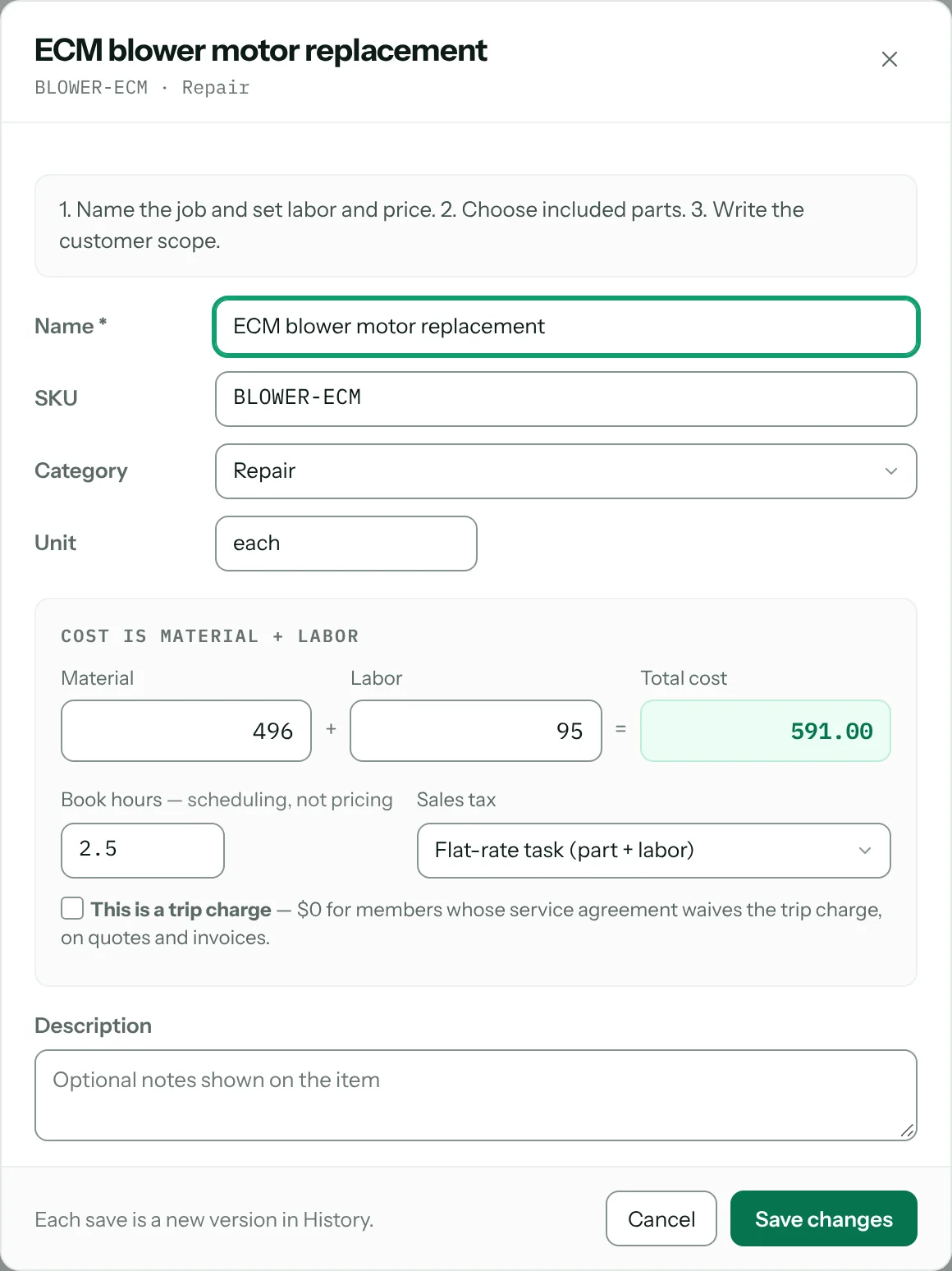
Included parts are internal. They are not extra charges on the quote, and the customer sees one price. Sizes of the same job can be grouped into a task family, and a size can be copied to the next one with its cost and price reviewed first. A task holds up to 50 parts, parts cannot contain other parts, and it does not turn existing parts into tasks for you. The Lista de precios vs. reloj report then compares each task's book hours with the hours clocked on finished single-task jobs.
Flat-rate tasks are included on Starter at $49 a month. Tasks also push to Jobber's Products & Services like any other artículo; Jobber flat rate pricing covers that side. Full steps are in the help doc, Crea tareas de precio fijo para cotizar.
Preguntas frecuentes
What is a flat-rate task?
A flat-rate task is one complete repair or install sold as a single line at a single price, agreed before work starts. Behind the line are the book hours, the parts the job uses and a written scope. The customer sees the scope and the price, not the hours or the parts list.
What are book hours?
Book hours are the time a task is sold for: the hours an average tech needs to finish the job on site on an average day. They set the labor cost inside the price and the time the job takes on the schedule. Comparing them with clocked hours shows which tasks are underpriced.
Should book hours include drive time?
No. Book hours should cover the work on site, from starting the repair to walking the customer through it. Drive time changes with every address, so it is recovered through a trip charge, a diagnostic fee or the hourly rate itself. Putting it in the task makes the same repair cost a different amount for every customer.
Should the customer see the parts inside a flat-rate task?
Usually not as priced lines. The point of a flat-rate task is one price for the finished job. Name the main parts in the scope, such as a new fan motor and a new run capacitor, so the customer knows what was fitted, and keep the part costs and quantities as your own internal record.
How often should you review a flat-rate task?
Review a task's price whenever a part in it changes cost, and its book hours a few times a year against clocked time. A task done 60 times a year that runs 30 minutes over gives away 30 hours. Change the hours or the price only when several jobs show the same overrun, not after one bad day.