To read an HVAC data plate, take four things off it every time: the full model number, the serial number, the refrigerant and factory charge, and the electrical ratings. The model number tells you what the unit is and how big it is. The serial number tells you which one it is and, on most brands, when it was built. Photograph the whole plate before you write anything down, because a typed serial number with one wrong character is worse than no serial number.
What is an HVAC data plate?
A data plate is the manufacturer's label on a piece of equipment. It is also called a nameplate, rating plate or data tag. It carries the model and serial numbers, the electrical requirements, the refrigerant and how much of it the factory put in, and the test pressures. Everything a distributor, a manufacturer or an inspector will ask you about that unit is on it.
On a condenser or heat pump the plate is on the outside of the cabinet, usually near the service valves or the electrical panel. On a furnace or air handler it is inside: Goodman, for example, puts it on the inner wall of the furnace or air handler, behind the door.
What should you record from a data plate on every call?
Record the same fields at every property, whether or not today's job needs them. The call that needs them is usually the next one, when you are quoting from the truck or ordering a part from the office.
| Field on the plate | Qué te dice | When you need it |
|---|---|---|
| Model number (M/N) | Product line, capacity, voltage and revision | Parts lookup, replacement quotes, matching indoor and outdoor units |
| Serial number (S/N) | The individual unit, and usually its build date | Warranty claims and registration, age, recalls |
| Refrigerant type | R-22, R-410A, R-454B, R-32 | What you can charge it with and what a repair will cost |
| Factory charge | Weight of refrigerant the unit shipped with | Weighing in a charge, estimating a recharge after a leak repair |
| Volts / phase / hertz | The supply the unit is built for | Ordering motors, contactors and the replacement unit |
| MCA | Minimum circuit ampacity | Checking the existing wire before a changeout |
| MOCP (or max fuse / breaker) | Largest breaker or fuse allowed | Checking the existing breaker before a changeout |
| Compressor RLA and LRA, fan FLA | Rated running current and starting current | Comparing against your amp readings |
| Design pressures (high / low) | The pressures the unit was tested to | Pressure testing after a repair |
A plate that is faded, painted over or missing is worth noting too. It is the reason a part order or a warranty claim will stall later, and the customer should hear that from you today.
How do you tell tonnage from the model number?
On most residential condensers and heat pumps, the model number contains the cooling capacity in thousands of BTU per hour. One ton of cooling is 12,000 BTU per hour, so the capacity digits divide by 12. Read them from the outdoor unit's model number, not its serial number: the model number identifies the equipment family and configuration, and the serial number identifies the individual unit.
| Digits in the model number | BTU per hour | Tons |
|---|---|---|
| 18 | 18,000 | 1.5 |
| 24 | 24,000 | 2 |
| 30 | 30,000 | 2.5 |
| 36 | 36,000 | 3 |
| 42 | 42,000 | 3.5 |
| 48 | 48,000 | 4 |
| 60 | 60,000 | 5 |
Where the digits sit depends on the brand and the product line. They can be near the end, in the middle, or written with a leading zero, as in 036. If a model number has two candidates, the plate's electrical ratings and the manufacturer's product data settle it. Furnaces work the same way with heating input: 080 in a furnace model number usually means 80,000 BTU per hour of input.
Tonnage is the first thing a replacement quote depends on. If you present good, better and best options, all three start from the size on the plate.
How do you tell how old a unit is from the serial number?
Look for a printed manufacture date first. Many newer plates state it outright, and a printed date needs no decoding. If there isn't one, the build date is usually coded into the first few characters of the serial number, and each manufacturer does it differently.
| Brand family | Where the date is | Example |
|---|---|---|
| Goodman, Amana | First two digits are the year, next two are the month | 1609… is September 2016 |
| Carrier, Bryant, Payne | First two digits are the week, next two are the year | 2311… is week 23 of 2011 |
| Trane, American Standard (2010 on) | First two digits are the year, next two are the week | 1135… is week 35 of 2011 |
| Lennox | Third and fourth digits are the year, followed by a letter for the month | 5807C… is March 2007 |
These are the current common formats, compiled from parts-distributor and building-inspection references: Goodman, Carrier, Trane, Lennox. Every one of these brands has used other formats in other decades, and Carrier and Trane read in opposite order, so a 4-digit code can decode two ways. When the answer matters, for a warranty claim or a replace-or-repair conversation, confirm it with the manufacturer or your distributor using the full model and serial number.
Remember that the serial number gives the build date, not the install date. Warranty terms often run from installation, which is one more reason to keep your own record of when you put a unit in.
What do MCA, MOCP, RLA and LRA mean on a nameplate?
These four numbers are the ones techs most often skip, and they are the ones that matter on a changeout.
- MCA, mínimo circuit ampacity. The smallest wire rating the circuit can have. It is the value used to select the minimum branch-circuit conductor size.
- MOCP, maximum overcurrent protection. The largest breaker or fuse the unit may be on. Some plates call it max fuse or max breaker.
- RLA, rated load amps. The compressor's rated running current. It is a design rating, so a healthy compressor often reads below it.
- LRA, locked rotor amps. The current the compressor draws at the instant it starts, several times its RLA.
The short version: MCA sizes the wire and MOCP caps the breaker. A new unit that replaces an old one of the same tonnage can still carry a different MCA and MOCP, so read the new plate against the existing circuit before you quote the job as a straight swap. Wire and breaker sizing follow the electrical code in force where you work; the plate gives you the numbers to check, not permission to skip the check.
Why does the refrigerant on the plate change the quote?
The refrigerant line tells you which era the system belongs to, and that sets the price of any repair that opens the sealed system.
- R-22. No new R-22 has been made or imported in the United States since January 1, 2020; only recovered and reclaimed supply remains. A leak on an R-22 system is a replace-or-repair conversation.
- R-410A. The EPA prohibited the manufacture of R-410A residential and light commercial air conditioning products starting January 1, 2025. Existing systems are still serviced.
- R-454B and R-32. What newer equipment ships with. Different refrigerant, different tools and handling.
Write the refrigerant and the factory charge on the equipment record. The office can then price a recharge before the truck rolls instead of after.
How should a shop store data plate information?
Keep it against the unit, not the job. A unit record holds the brand, model, serial, refrigerant, filter size and install date for one piece of equipment at one address, and every later job, reading and photo attaches to it. Stored that way, the plate gets read once.
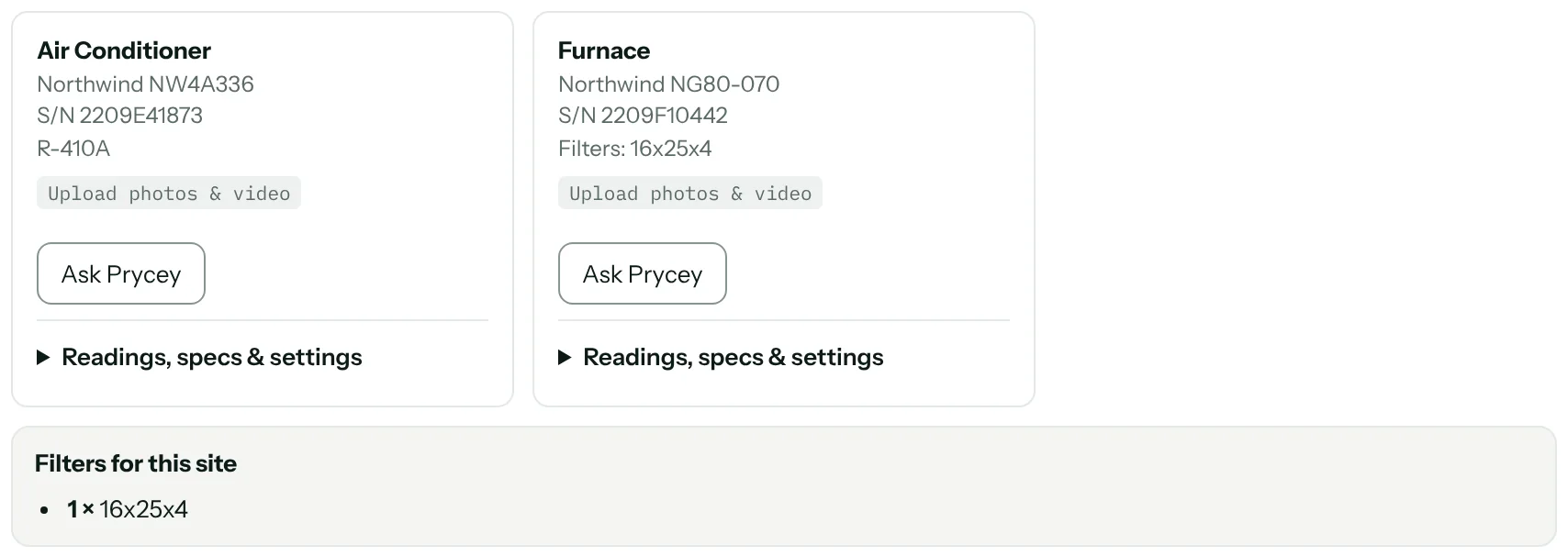
Three habits make the record trustworthy:
- Photograph the whole plate, square on, before anything else. The photo is the evidence; the typed fields are a copy of it.
- Have a second look at the transcription. Serial numbers mix O and 0, I and 1, S and 5.
- Record both halves of a split system. The indoor and outdoor units have separate model and serial numbers, and a warranty registration needs both.
Pricebookr's field app does the first two for you: the tech photographs the plate, the data plate scanner reads the brand, model, serial number and ratings, and nothing is saved until a person checks the reading against the photo. Confirmed units feed the cola de registro de garantía and the property's historial de equipos. A maintenance agreement is also easier to honor when the units it covers are on file.
Conclusión clave: photograph the plate, then record model, serial, refrigerant and charge, and the electrical ratings against the unit. Size comes from the model number, age from the serial number, and the wire and breaker check from MCA and MOCP.
Preguntas frecuentes
Where is the data plate on an air conditioner or furnace?
On an outdoor condenser or heat pump, the data plate is on the outside of the cabinet, usually near the refrigerant service valves or the electrical access panel. On a furnace or air handler it is inside the cabinet, on an inner wall behind the door. Turn the power off before removing a furnace panel to read it.
What is the difference between a model number and a serial number?
The model number identifies the design: product line, capacity, voltage and revision. Every unit of that design shares it. The serial number identifies one individual unit and usually encodes when it was built. You need the model number to find parts and the serial number for warranty claims and age.
How many tons is my AC unit?
Find the two or three capacity digits in the outdoor unit's model number and divide by 12. The digits are thousands of BTU per hour and one ton is 12,000 BTU per hour, so 24 is 2 tons, 36 is 3 tons, 48 is 4 tons and 60 is 5 tons.
Can I size a breaker from the MCA on the nameplate?
No. MCA is the minimum circuit ampacity and is used to size the wire. The breaker or fuse is limited by MOCP, the maximum overcurrent protection, which is a separate number on the same plate. Both are subject to the electrical code in force where the unit is installed.
What if the data plate is unreadable?
Note that it is unreadable and photograph it anyway. Check for a second label inside the cabinet, the installation paperwork, or the labels on the compressor and motors. A distributor or the manufacturer can sometimes identify a unit from a partial model number, but do not guess a serial number: a wrong one will fail a warranty claim.